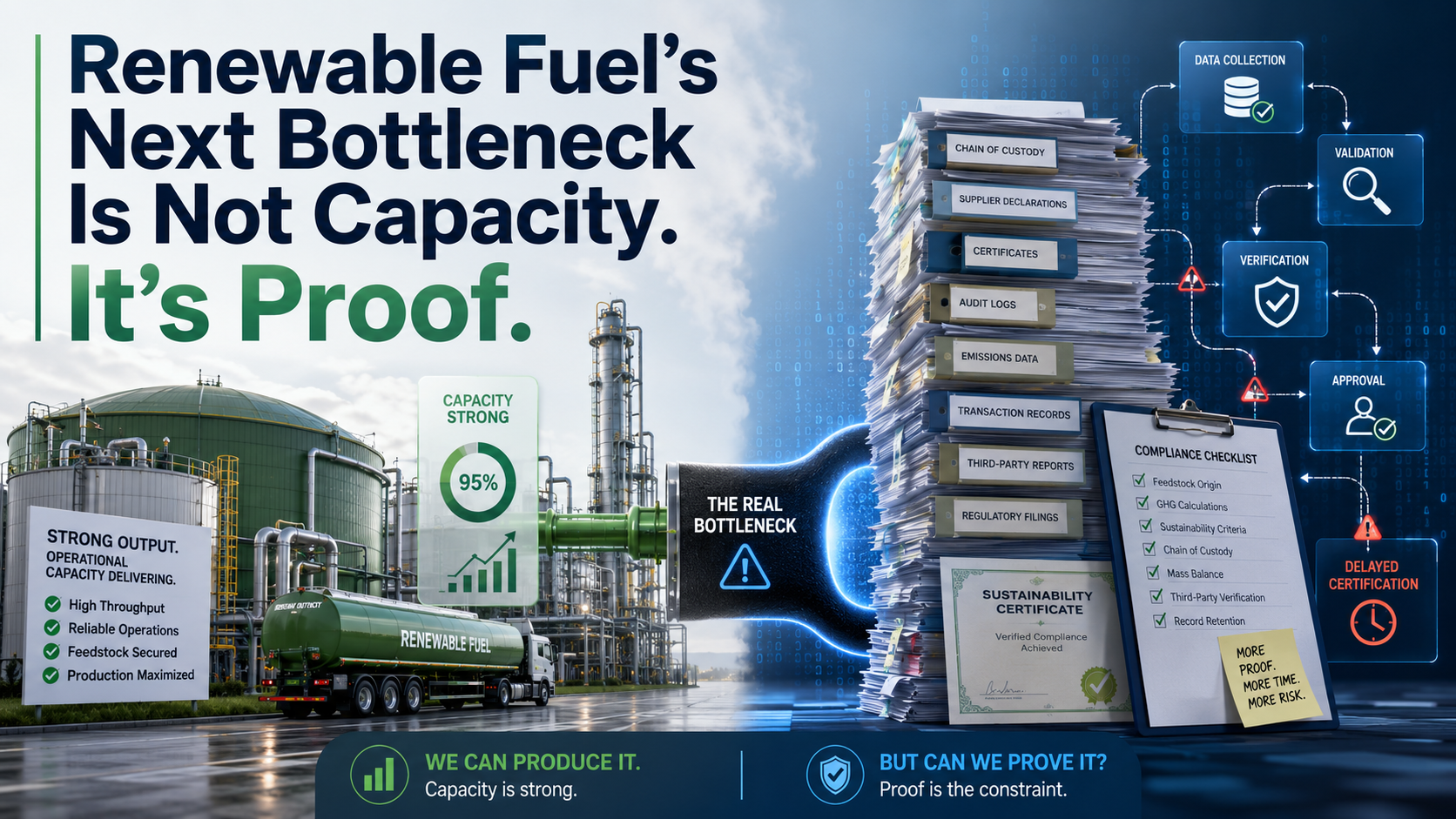
As federal and state clean-fuel programs become more valuable and more demanding, renewable fuel producers need to treat compliance data as operating infrastructure—not back-office paperwork.
For much of the past decade, the renewable diesel story has been a capacity story. Refiners converted hydroprocessing units. New plants came online. Feedstock buyers chased used cooking oil, tallow, distillers corn oil, soybean oil, canola oil, and other qualifying inputs. Traders watched RINs, LCFS credits, diesel spreads, and feedstock differentials to determine where the next margin would come from.
The next bottleneck in renewable diesel will not be whether the industry can produce molecules. It will be whether producers can prove, quickly and defensibly, what those molecules are, where the feedstock came from, how it moved, which certificates applied, what carbon intensity assumptions were used, and whether the supporting documentation can survive review.
U.S. renewable diesel capacity has grown rapidly, and federal policy continues to support demand for biomass-based diesel. At the same time, programs such as the Renewable Fuel Standard, California’s Low Carbon Fuel Standard, and the federal 45Z Clean Fuel Production Credit are making the data behind each gallon more commercially important.
Those programs do not simply reward production. They reward qualified, documented, traceable production.
The gallon is only as good as its documentation
A renewable diesel producer does not just receive feedstock. It receives a bundle of evidence.
That evidence may include a bill of lading, scale ticket, sustainability declaration, supplier certificate, supplier record, truck or rail delivery data, weight information, feedstock classification, point-of-origin information, contract terms, and internal production allocation records.
Some arrive as PDFs. Some are scans. Some contain handwritten annotations. Some are attached to emails. Some live in ERP systems, transportation systems, spreadsheets, shared drives, or third-party portals.
This is where the operational bottleneck begins.
In many renewable diesel operations, compliance data still lives across spreadsheets, PDFs, paper records, ERP systems, transportation platforms, email inboxes, and supplier documents. A Rimba implementation with a renewable diesel producer showed the same pattern: bills of lading, scale tickets, sustainability declarations, certificate records, and distance calculations were all critical to the compliance workflow, but much of the source data began in fragmented or unstructured formats.
That fragmentation is not merely inconvenient. A wrong feedstock classification can affect program eligibility. A stale supplier certificate can create audit exposure. A missing bill of lading can delay verification. A distance calculation entered inconsistently across spreadsheets can affect carbon intensity reporting.
Compliance is becoming a data engineering problem
The industry has historically treated compliance as a reporting function.
The plant produces. Logistics moves product. Accounting closes the books. Then the compliance team assembles the evidence. Under today’s clean-fuel programs, compliance is not just a quarterly or annual reporting exercise. It is a continuous data-engineering challenge. Producers need to know whether the right documents have been captured, whether the fields extracted from those documents are accurate, whether the supplier’s certification was valid at the time of delivery, whether the movement distance is calculated consistently, whether the feedstock is eligible for the intended program, and whether the full chain of evidence can be reproduced later.
In one Rimba implementation for a renewable diesel producer, the workflow centered on five practical steps: data collection, extraction, validation, template-based output generation, and continuous learning. The implementation included email ingestion, bulk document upload, OCR, handwriting recognition, field detection, confidence scoring, certificate validation, distance calculations, and outputs into customer-specific Excel reports or dashboards.
The future compliance stack will need to answer five questions:
- Can we capture the document automatically?
- Can we extract the relevant fields accurately?
- Can we validate the extracted data against certificates, supplier records, and business rules?
- Can we flag uncertainty before it becomes a silent error that is only discovered during audit?
- Can we simplify locating the evidence and preparing the audit package without it being a stressful process each audit cycle?
The weakest link is often the document
The most fragile part of renewable fuel compliance is not always the regulation itself. It is the document that proves compliance.
That is why generic OCR is insufficient. Compliance and data teams do not need software that can merely read text on a page. They need software that understands context: which field matters, how that field maps to a compliance report, when a confidence score is too low, and when a human should review the result.
High-confidence extractions should move quickly. Low-confidence fields should be routed for review. New document formats should be identified and learned. Corrections should improve future extraction. The compliance team should not review every field manually, but it also should not discover a silent extraction error during verification or audit.
Certificates need lifecycle management, not folders
Certificate management should become a live control.
For producers, this matters commercially. If a compliance team discovers after the fact that a counterparty certificate was expired or missing, the issue can trigger rework, delay reporting, or create uncertainty over whether a batch should be included in a given program.
For example, Rimba automatically checks ISCC certificate numbers in a Sustainability Declaration against the ISCC certificate database.
The same logic applies to distance calculations.
In renewable diesel and LCFS-related workflows, distance assumptions can matter. But distance data is often looked up manually, copied into spreadsheets, and maintained inconsistently. The same Rimba implementation showed supplier distance calculation as a workflow that supports different transportation modes, including truck and rail, and generates distance metrics for compliance reporting.
Producers should build a proof layer before they need it
The temptation is to solve compliance data problems only when an audit, verification cycle, or reporting deadline forces the issue. That is understandable. Compliance teams are already stretched, and data teams are often focused on ERP, plant data, cybersecurity, finance, and trading systems.
But the cost of building proof infrastructure after the fact is higher. That is not a scalable approach for an industry moving into more market optionality for compliance programs and more granular eligibility requirements.
Compliance data belongs to the producer. Any system used to manage it should make the data more usable, not trap it. With Rimba, data portability was treated as a core requirement: users could export information into Excel or CSV formats, making it easy to cross-verify the output.
The compliance team should become exception managers
The goal is not to remove people from compliance.
A strong compliance data system should let teams spend less time copying values from bills of lading into spreadsheets and more time reviewing exceptions, resolving discrepancies, improving controls, and preparing defensible reports.
This is where AI has a useful role—but only if it is designed for regulated operations.
For renewable diesel, AI should not be a black box that produces final answers without context. It should be a control layer that reads documents, extracts structured data, checks confidence, validates against external sources where possible, and escalates uncertainty to humans.
The Rimba implementation with a renewable diesel producer showed this model in practice: document extraction, confidence scoring, certificate validation, expiry alerts, distance calculation, customer-template outputs, and adaptation to new document formats.
That is the practical version of AI for renewable fuels.
Not a chatbot sitting beside the business. Not a generic document reader. Not a compliance dashboard disconnected from source evidence. The more useful model is workflow automation embedded into the evidence chain.
The market will reward producers who can prove faster
A producer that can assemble clean, validated, source-linked reporting data quickly has a commercial advantage. It can reduce reporting delays. It can respond to audit and verification requests with less disruption. It can onboard suppliers more confidently. It can identify missing or expired documentation earlier. It can give commercial teams better visibility into which gallons are eligible for which programs.
That advantage becomes more important as policy complexity increases.
The RFS continues to support biomass-based diesel demand. The 45Z credit ties clean-fuel value to emissions factors and eligibility requirements. LCFS programs are putting more pressure on feedstock traceability, sustainability documentation, and carbon-intensity support.
Together, these programs create opportunity. They also raise the standard of proof. Because the market is no longer asking only: can you make the gallon?
It is asking: can you prove the gallon?
And increasingly, the producer that can prove it fastest will be the producer best positioned to monetize it.
If you're dealing with siloed, fragmented data across Excel, SAP, or other ERP systems — or your team is spending hours every week manually collecting, sorting, and reconciling supply chain data — come talk to our solutions team.
📧 start@rimba.ai | 🌐 www.rimba.ai