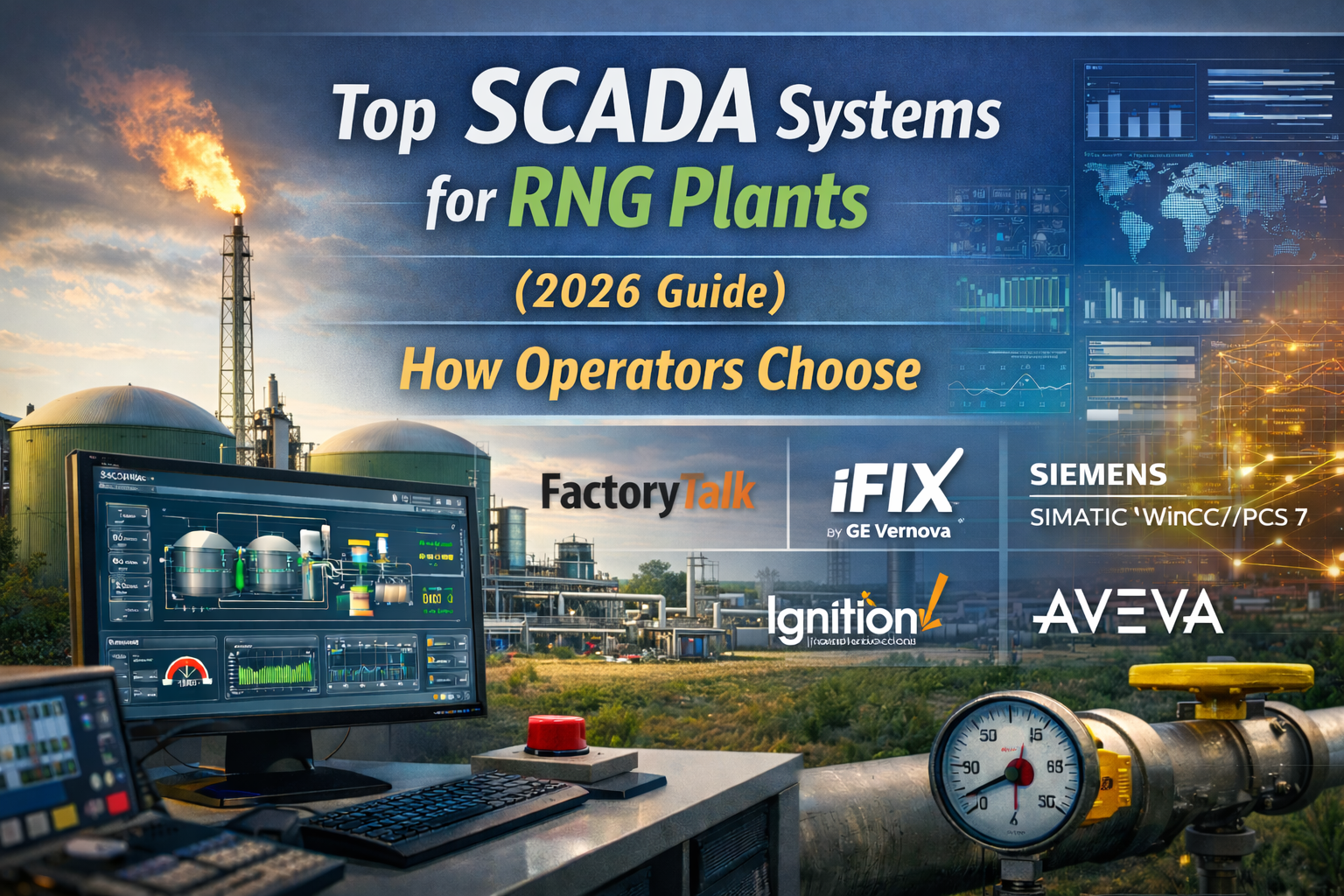
Top SCADA Systems Used in RNG Plants
(2026 Guide):
How Operators Choose the Right One

As RNG projects scale, operators need reliable SCADA systems to manage complex facilities.We break down the most common platforms used in the industry and how teams select them.

Wildfire Reduction Market Expansion Act of 2026: What It Means For Renewable Fuel Producers — Rimba

Wildfire Reduction Market Expansion Act of 2026: What It Means For Renewable Fuel Producers

The bipartisan bill introduced on July 22nd would expand the Renewable Fuel Standard's (RFS) definition of renewable biomass to include woody materials from wildfire prevention. For cellulosic ethanol and SAF producers, there are significant implications.

01The gap in the current RFS definition

The RFS defines which raw materials count as “renewable biomass” under Section 211(o)(1)(I) of the Clean Air Act. Only fuels produced from qualifying feedstocks generate Renewable Identification Numbers (RINs) which are the compliance credits that producers get paid for.

Under the current definition, much of the woody material removed during forest thinning and wildfire prevention does not qualify. Pre-commercial thinnings, storm debris, slash, and brush cleared from defensible space around structures all fall outside the RFS's biomass eligibility criteria, despite already being removed from forests and wildlands as part of routine land management.

Without the RFS-linked financial incentive to convert it into renewable fuel, it is typically burned in open-air piles, left to decompose or hauled to landfills. All three outcomes release carbon. None generate RINs.

02What the Wildfire Reduction Market Expansion Act changes

Proposed on July 22nd 2026, the bill would amend Section 211(o)(1)(I) of the Clean Air Act to broaden what qualifies as renewable biomass under the RFS.

Expanded forest products manufacturing materials

The bill adds several material types to the list of eligible biomass from forest products manufacturing:

  • Wood residuals
  • Paper residuals
  • Sawdust, wood chips, and shavings
  • Bark and sander dust
  • Paper recycling residuals

These materials were previously excluded despite being generated as byproducts of commercial forestry operations.

New eligible land categories

The bill opens three new categories of land from which woody biomass can be sourced for RFS-qualifying fuel production.

Non-federal land

Biomass from private land qualifies if it is enrolled in a forest sustainability certification program, classified as timberland for tax purposes, or if the landowner certifies it is managed for long-term timber production.

National Forest System and public lands

Material from fuel reduction treatments and ecological restoration on federal land becomes eligible, as long as it is not suitable for use as sawlogs and the sourcing complies with the applicable forest management plan. The plan does not need to mention renewable fuel production as an intended use.

Tribal land

Land owned by an Indian tribe or held in trust is also included.

Defensible space and wildland-urban interface materials

Vegetation removed as part of defensible space clearing around structures (and material from wildfire risk reduction activities in the wildland-urban interface) also becomes eligible under the amended definition.

03Why it matters for renewable fuel producers

The most direct impact is on cellulosic ethanol and SAF producers. The bill opens up forest thinning material and wildfire prevention residues as eligible feedstock for transportation fuel, including aviation fuel. For producers who have been constrained by feedstock availability, this is a significant expansion of what they can work with.

A UC Davis study found that every dollar invested in forest fuel reduction treatments saves roughly $3.75 in wildfire suppression and damage costs. By creating a market for this material through the RFS, the bill gives wildfire prevention a brand new revenue stream.

04New compliance and documentation requirements

New feedstock categories come with new compliance obligations. Producers sourcing woody biomass under the amended definition will need to:

  1. Maintain certification letters from landowners or federal field offices
  2. Verify that federal land material is not suitable for use as sawlogs
  3. Confirm that sourcing complies with the applicable forest management plan
  4. Document the full chain of custody from origin to fuel production

For organisations already managing feedstock documentation across LCFS, RFS, or ISCC, this adds another layer. For those still relying on spreadsheets and email chains, it may be worth considering whether existing systems can handle the additional documentation load.
Top SCADA Systems Used in RNG Plants

FactoryTalk (Rockwell Automation)

FactoryTalk is one of the most widely used SCADA platforms in North American industrial automation.
Many RNG plants rely on Allen-Bradley PLCs, making FactoryTalk a natural choice due to its tight integration with Rockwell control hardware.

Why Operators use it:
  • strong industrial automation ecosystem
  • large integrator network
  • common in gas processing and manufacturing plants

Ignition (Inductive Automation)

Ignition has rapidly become one of the fastest-growing SCADA platforms in the industrial automation sector.
Unlike traditional SCADA systems, Ignition is built around web-based architecture, making it well suited for remote monitoring and multi-site operations.

Key points:
  • web-based dashboards
  • flexible integrations
  • scalable licensing model

GE Vernova – iFIX / Proficy

GE’s iFIX platform has long been used in industrial process monitoring.
In RNG facilities, it is often deployed in plants that require strong data historian capabilities and integration with existing industrial automation infrastructure.

Typical use cases include:
  • large anaerobic digestion facilities
  • industrial gas processing plants
  • complex upgrading systems

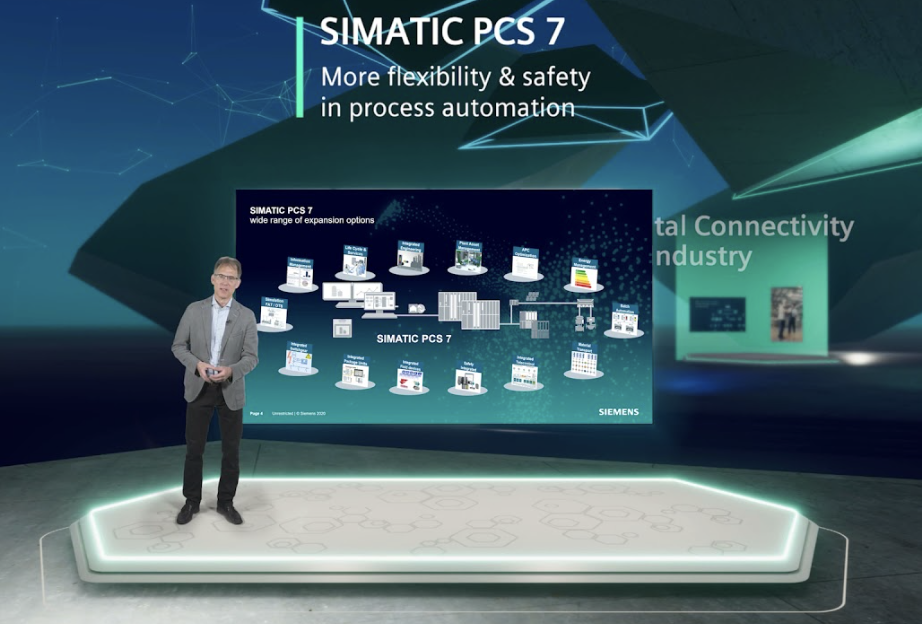
Siemens WinCC / PCS7

GE’s iFIX platform has long been used in industrial process monitoring.
In RNG facilities, it is often deployed in plants that require strong data historian capabilities and integration with existing industrial automation infrastructure.

These systems are commonly found in:
  • municipal digesters
  • large wastewater facilities
  • industrial RNG processing plants

Wonderware (Aveva)

AVEVA’s System Platform (formerly Wonderware) is widely deployed in industrial automation environments.
The platform is known for strong visualization and process monitoring capabilities, making it common in facilities that require detailed operational dashboards.

Typical deployments include:
  • wastewater treatment plants
  • landfill gas facilities
  • industrial biogas plants

VTScada

VTScada is frequently used in infrastructure monitoring environments such as water utilities and gas distribution networks.
Some RNG operators deploy VTScada for remote monitoring of distributed digester systems.

Strengths include:
  • reliable alarm management
  • remote telemetry monitoring
  • scalable infrastructure monitoring

How RNG Operators Choose a SCADA System

Selecting the right SCADA platform for an RNG facility depends on several operational and technical factors. While most SCADA systems provide similar core functionality, operators typically prioritize compatibility, scalability, and data accessibility.

PLC Compatibility

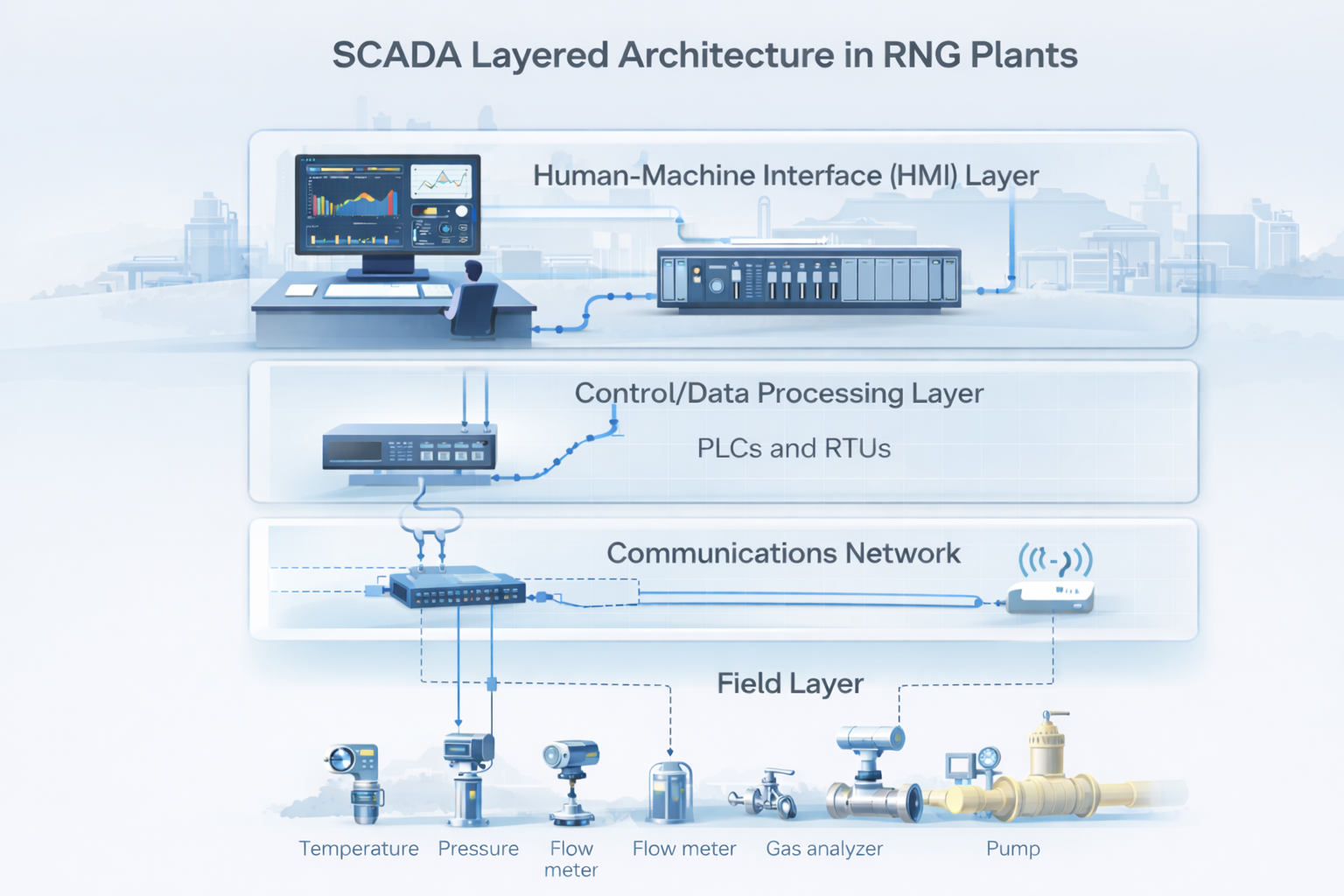
Most RNG plants rely on programmable logic controllers (PLCs) to control equipment such as digesters, gas upgrading systems, compressors, and pipeline injection infrastructure.

Common PLC platforms include:

Multi-Site Monitoring

As RNG portfolios expand, many operators manage multiple facilities across different regions.
In these cases, centralized monitoring becomes increasingly important. Platforms such as Ignition and FactoryTalk are commonly used to monitor multiple RNG plants from a single operations center.

This allows operators to:

Ease of Operation

Operators often spend hours each day interacting with SCADA screens, especially in facilities where digesters, upgrading systems, and compressors must be monitored continuously. When interfaces are poorly designed or cluttered, it becomes much harder to identify problems quickly.

Good SCADA deployments typically prioritize:

The Future of RNG Operations Software

The RNG industry is still relatively early in its digital transformation.

Most facilities today rely heavily on SCADA systems that were originally designed for industrial process control, not for portfolio-level operational insight.

As operators scale to dozens of plants, a new category of software is beginning to emerge on top of SCADA systems.

These platforms focus on:

  • methane yield optimization
  • carbon intensity (CI) tracking
  • cross-facility performance monitoring
  • predictive maintenance

Rather than replacing SCADA, these tools use SCADA data to provide higher-level operational intelligence across multiple plants.

For operators managing growing RNG portfolios, this additional software layer is becoming increasingly important.