
The finalized "Set 2" rule under the Renewable Fuel Standard sets blending obligations at historic highs, requiring a major ramp-up in biodiesel and renewable diesel output.
The U.S. Environmental Protection Agency has finalized sweeping renewable fuel requirements for the next two years, setting volume mandates that officials say are the largest in the 20-year history of the Renewable Fuel Standard program. The rule, known as "Set 2," was announced at a White House agriculture event and is positioned by the Trump administration as a cornerstone of its domestic energy and farm policy agenda.
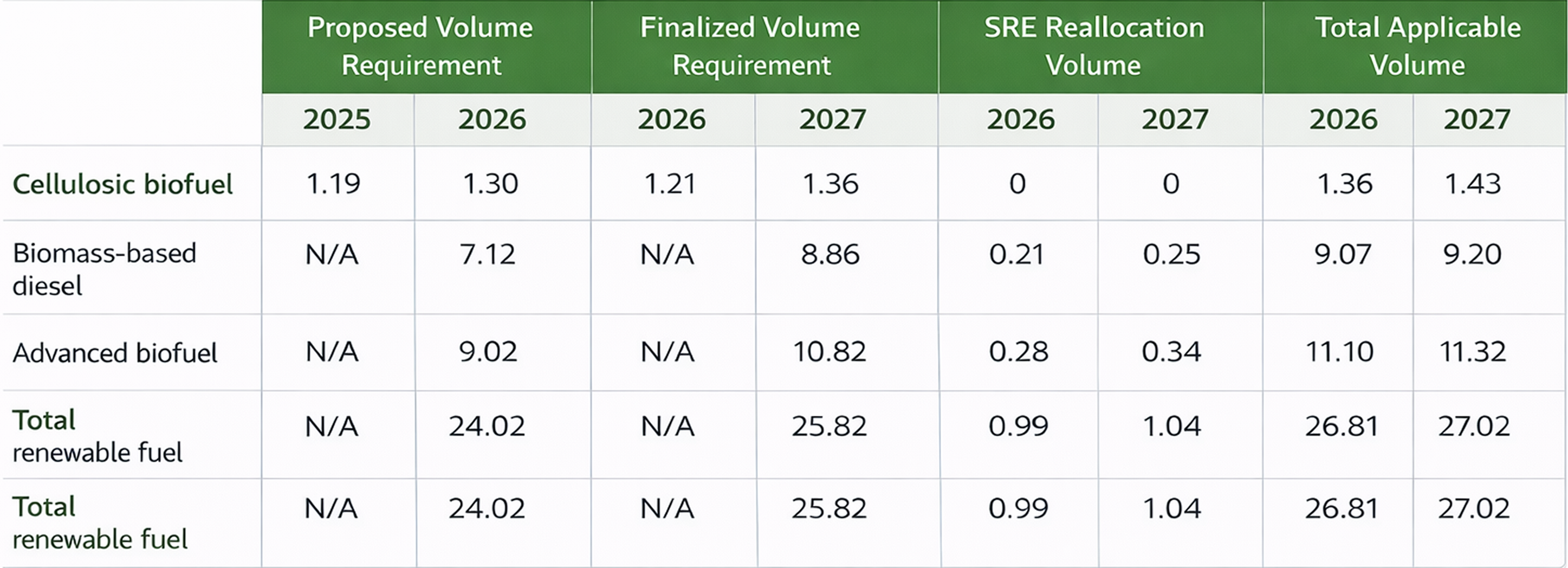
The final rule sets the total applicable renewable volume obligation at 26.81 billion RINs for 2026 and 27.02 billion for 2027. Those figures are significantly above the requirements finalized under the previous administration for 2025, and analysts say meeting them will demand a substantial expansion of the biodiesel and renewable diesel sectors. EPA estimates that production in those categories will need to grow by more than 60 percent compared to 2025 output — a shift that officials say will translate directly into stronger demand for American soy, corn, and other agricultural feedstocks.
"This is not just a little incremental baby step forward. This is a big leap forward."
Geoff Cooper, president and CEO, Renewable Fuels AssociationGeoff Cooper, who leads the Renewable Fuels Association, called the announcement a historic win for the renewable energy and agricultural industries. He noted that the new requirements would push renewable fuels to comprise roughly 15 percent of the national fuel supply and said the farm income impact could be substantial. Federal estimates from USDA and EPA project that the rule could add between $3 billion and $4 billion to net farm income annually over the next two years — a significant injection at a time of financial stress in the sector.
The EPA also finalized a partial reallocation of previously exempted volume obligations from 2023 through 2025. Under the rule, 70 percent of the renewable volume obligations covered by small refinery exemptions during those years will be redistributed across the 2026 and 2027 compliance periods. The reallocation adds approximately 990 million RINs in 2026 and 1.04 billion RINs in 2027, including meaningful volumes in the advanced biofuel and biomass-based diesel categories.
Brian Jennings, chief executive of the American Coalition for Ethanol, praised the new requirements in a statement, emphasizing that the rule should be seen as an implementation of Congress's original intent — that blending volumes would increase year over year. He also underscored the importance of ensuring that any future small refinery exemptions are fully offset so that volume obligations translate into real fuel demand rather than paper compliance.
On conventional ethanol, the agency maintained the existing 15 billion gallon statutory level for both years, providing continuity for corn growers and ethanol producers who depend on stable program signals to make capital and planting decisions. Cooper said that certainty, combined with the expansion in advanced biofuel categories, creates a strong foundation for investment across the renewable fuels sector.
One significant provision proposed last June — a measure that would have cut in half the compliance value of RINs generated from imported biofuels and feedstocks — was not included in the final rule. The EPA acknowledged in regulatory documents that commenters raised concerns that the proposed import RIN reduction could cause significant market disruption and potentially push up prices for gasoline and diesel consumers if implemented without sufficient preparation time. The agency said it intends to establish such provisions in time for the 2028 compliance year, giving the market roughly two years to prepare for the change.
Officials estimate that the expanded use of American-made ethanol, biodiesel, and renewable diesel under the new rule would reduce crude oil import dependency by approximately 300,000 barrels per day over the two-year period. The administration has framed the rule as both an energy security measure and an economic development tool, projecting that it will generate more than $10 billion for rural economies and support more than 100,000 jobs in agriculture and manufacturing.